
Table Of Contents
- HR Job Titles Explained: From HR Administrator to HR Director
- Why HR Job Titles Vary So Much in the UK?
- Entry-Level HR Roles: HR Administrator and HR Assistant
- Early Advisory Roles: HR Officer
- Advisory Roles: HR Advisor
- Managerial and Strategic Roles: HR Manager and HR Business Partner
- Senior Leadership Roles: Head of HR and HR Director
- Choosing the Right HR Role and CIPD Level for You
- A Supportive Next Step
If you are exploring a career in HR in the UK, one of the first challenges you may encounter is understanding HR job titles. Roles such as HR Administrator, HR Advisor, HR Business Partner and HR Director are widely used, yet they can mean very different things depending on the organisation, sector and size of the business.
For career changers, aspiring HR professionals and CIPD learners, this lack of consistency can create uncertainty. Many people worry about applying for roles that feel either out of reach or misaligned with their experience, simply because the job title is unclear.
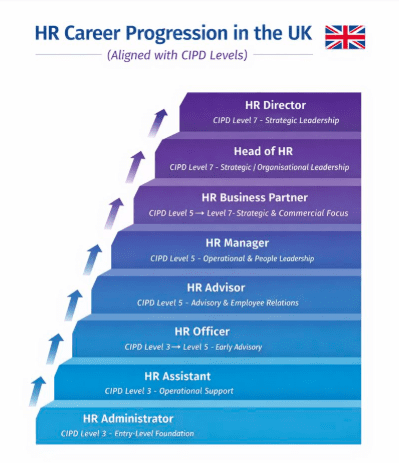
This blog explains common HR job titles in the UK, what each role typically involves, how responsibility increases across levels, and how these roles align with CIPD Levels 3, 5 and 7. The aim is to help you understand the reality of HR work in 2026 and make informed, confident career decisions.
Why HR Job Titles Vary So Much in the UK
HR job titles are not legally protected. This means organisations can name roles in ways that suit their internal structure, even when the scope of work differs significantly.
In smaller organisations, one HR professional may cover the full employee lifecycle, while in larger organisations, HR responsibilities are spread across specialist and strategic roles. As a result, the same title can represent very different levels of responsibility.
This is why it is essential to look beyond the job title and focus on what the role actually involves, how much autonomy it carries, and what level of professional judgement is expected.
Entry-Level HR Roles: HR Administrator and HR Assistant
(Typically aligned with CIPD Level 3)
HR Administrator
The HR Administrator role is often the starting point for those new to HR or transitioning into the profession. It focuses on the operational backbone of HR and provides essential exposure to how people practice function day to day.
Responsibilities usually include maintaining employee records, issuing contracts and letters, supporting recruitment administration, updating HR systems and responding to routine queries. Accuracy, confidentiality and attention to detail are critical.
While this role can feel process-driven, it builds the foundations of effective HR practice. It aligns closely with CIPD Level 3, which introduces learners to core people practices, ethical behaviour and employment fundamentals.
HR Assistant
HR Assistant roles are similar to HR Administrator positions but may involve broader people interaction. This can include supporting onboarding, coordinating training activities or assisting with basic employee relations administration.
For many learners, this role is where confidence begins to develop. Applying learning from CIPD Level 3 in real situations helps individuals understand how theory translates into workplace practice.
Early Advisory Roles: HR Officer
(Transition between CIPD Level 3 and Level 5)
The HR Officer role sits between administration and advisory practice. It often involves greater responsibility and exposure to decision-making, while still operating with guidance from senior HR colleagues.
HR Officers may support managers with straightforward people issues, contribute to policy implementation and assist with HR projects. This role requires the ability to interpret guidance rather than simply follow instructions.
Many professionals step into HR Officer roles while studying or completing CIPD Level 5, as this level develops the confidence and analytical thinking needed to operate beyond purely administrative tasks.
Advisory Roles: HR Advisor
(Strongly aligned with CIPD Level 5)
HR Advisor roles represent a significant shift in the HR career path UK. At this level, individuals are expected to provide professional advice to managers on performance, absence, disciplinary and grievance matters.
The role involves emotional labour, ethical responsibility and professional judgement. HR Advisors must balance organisational priorities with fairness, consistency and employee wellbeing, often in complex or sensitive situations.
CIPD Level 5 is closely aligned with this role, as it develops advisory capability, evidence-informed decision-making and the ability to influence others with credibility.
Managerial and Strategic Roles: HR Manager and HR Business Partner
(Aligned with CIPD Level 5 and progression towards Level 7)
HR Manager
HR Manager roles vary significantly depending on organisational context. In smaller organisations, the HR Manager may be responsible for the entire HR function, combining operational delivery with strategic input.
In larger organisations, HR Managers often lead teams or specialist areas such as employee relations or learning and development. Leadership, accountability and risk management are central to the role.
CIPD Level 5 supports HR Manager capability, but as responsibility increases, many professionals begin developing skills aligned with CIPD Level 7, particularly in areas such as organisational design, leadership and strategic thinking.
HR Business Partner
The HR Business Partner (HRBP) role focuses on aligning people strategy with organisational goals. HRBPs work closely with senior leaders to support workforce planning, organisational change and capability development.
This role requires strong commercial awareness, influencing skills and confidence in operating at senior levels. While HRBP roles are sometimes advertised at Level 5, many organisations expect capability aligned with CIPD Level 7, particularly where the role is genuinely strategic rather than operational.
Senior Leadership Roles: Head of HR and HR Director
(Strongly aligned with CIPD Level 7)
Head of HR
The Head of HR role typically oversees HR strategy and operations across an organisation or division. It involves shaping culture, advising senior leaders and ensuring people practices support long-term organisational sustainability.
This role requires advanced professional judgement, leadership capability and a deep understanding of organisational dynamics. CIPD Level 7 is commonly aligned with this level of responsibility, as it develops strategic, systems-based thinking.
HR Director
HR Director is one of the most senior roles within the people profession. HR Directors sit at executive or board level and are accountable for the organisation’s people strategy, culture and ethical practice.
The role demands commercial awareness, ethical leadership and the confidence to challenge constructively. In the UK, HR Directors are often Chartered Members or Fellows of the Chartered Institute of Personnel and Development, with CIPD Level 7 forming a key part of their professional development journey.
Choosing the Right HR Role and CIPD Level for You
Understanding how HR roles align with CIPD levels helps you make realistic, confident decisions. Entry-level roles align well with Level 3, advisory and managerial roles with Level 5, and senior strategic roles with Level 7.
Progression in HR is rarely linear. Many professionals move sideways, specialise or take time to build depth before moving upward. What matters most is readiness, support and reflective development, not rushing to match a job title.
A Supportive Next Step
Understanding HR job titles and how they align with CIPD Levels 3, 5 and 7 is a vital step in building a sustainable people management career. Clarity helps you set realistic goals, choose appropriate learning pathways and build confidence over time.
At We-are-HR, we act as a learning partner rather than a sales provider. We support individuals to understand the realities of HR work, explore structured learning options and make informed decisions that align with their experience, aspirations and wellbeing.
A career in HR is built thoughtfully, not rushed, and understanding the roles is where that journey begins.